
Converging Artificial Intelligence (AI) and Capillary Microfluidics Simulation in Lab-on-a-Chip
A research collaboration integrating analytical modeling, CFD and AI tools to better understand capillary-driven microflows in Lab-on-a-Chip systems.
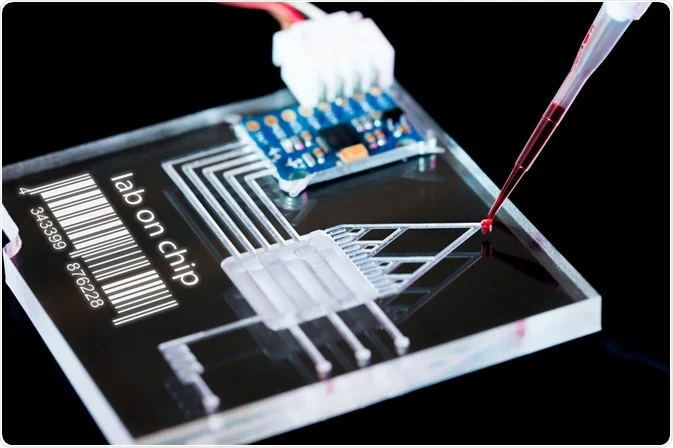
Project Overview
This project investigates capillary penetration and transport in microchannels with different geometries, including circular, rectangular and elliptical ducts. The work combines analytical modeling and numerical simulations to capture how surface tension, viscous effects and channel shape govern fluid motion at the microscale.
Stage 1 (literature review) and Stage 2 (CFD analysis) of the Mitacs proposal have been successfully completed. The research now progresses toward integrating AI-driven analysis on the generated simulation and theoretical data.
Project Stages
- Stage 1: Comprehensive literature review on capillary microflows.
- Stage 2: CFD and analytical modeling of penetration in various geometries.
- Next: Extending simulations and applying AI tools for pattern discovery and design optimization.
Study 1 – Capillary Penetration in Circular and Rectangular Microchannels
Analytical Framework
This study presents an analytical examination of the capillary penetration phenomenon for laminar, incompressible flow in circular and rectangular microchannels. The governing motion equation includes all relevant forces:
- Momentum of the liquid column
- Hydrostatic pressure
- Capillary force
- Viscous (retarding) force
The resulting model predicts the evolution of liquid-column length over time for different dimensionless parameters and channel cross-sections.
Key Results
- Penetration length increases with time, with distinct trends in circular vs rectangular channels.
- Dimensionless parameters such as m and p control the rate of capillary advancement.
- The framework can be used to compare and design microchannel geometries for targeted penetration behavior.
 Example results: column length vs time for circular and rectangular cross-sections.
Study 2 – Capillary Transport in Elliptical Microchannels
Theoretical Model
A detailed theoretical model is developed for capillary penetration in elliptical microchannels. By considering all acting forces and appropriate initial conditions, an analytical solution is derived for the penetration length as a function of time.
Two key dimensionless parameters are introduced:
- α – representing the capillary force contribution.
- β – representing the viscous resistance.
Main Insights
- Increasing α strengthens capillary forces and enhances penetration.
- Increasing β intensifies viscous effects and reduces penetration flow.
- The aspect ratio k = b/a distinguishes oblate, circular and prolate shapes, which exhibit different penetration behaviors.
- For the same cross-sectional area, prolate shapes can enhance penetration compared to circular and oblate geometries.
 Sample plots: influence of α, β and aspect ratio on penetration length.
Study 3 – Direct Numerical Simulation using Lattice Boltzmann Method
LBM for Capillary Microfluids
The third study employs the lattice Boltzmann method (LBM) to simulate surface-tension-driven two-phase flows in microchannels. The developed code is validated by modeling droplets on both hydrophilic and hydrophobic surfaces.
The simulations demonstrate that LBM is a powerful and efficient tool for direct numerical simulation (DNS) of capillary microfluids.
Simulation Examples
- Droplet spreading and equilibrium shapes on hydrophilic vs hydrophobic surfaces.
- Interface evolution within a microchannel under capillary-driven flow.
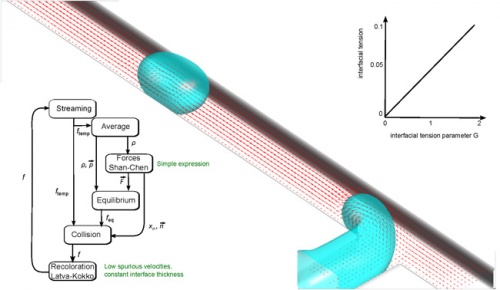 Interface position at different times obtained from LBM simulations.
Downloads
For more detailed equations, derivations and figures, download the full documents: